MySpace SWOT Analysis
Currently Youth Noise offers a MySpace profile which showcases a blog feature. However,
Youth Noise doesn’t allow users to learn about other campaigns Youth Noise partakes in.
Strengths:
• Strong Friend Count
Weaknesses/Threats:
• Generic (Skin)
• No Videos Visible
• Not Enough Photos
• Out Dated Blog
Opportunities:
• Convert Users onto Youth Noise
• Expose Blogs and Campaigns to Community Users
• Develop Applications for Community Users
Action Plan:
The following steps will be taken to convert opportunities into outcomes:
1. Re-Skin Account
a. Background Layout
2. Add Campaign Images and Links
3. Include Play City Blog Through RSS Feed
4. Develop Strategies to Increase Users Activity on Profile
Twitter SWOT Analysis
Currently Youth Noise offers tweets which link back to the site. However, Youth Noise
doesn’t allow users to understand Youth Noise’s position and values.
http://youthnoise.com/karoline/YNstrategy_SAMPLE.pdf
Showing posts with label Ruqia Arain. Show all posts
Showing posts with label Ruqia Arain. Show all posts
Monday, January 11, 2010

Facebook SWOT analysis
Facebook SWOT Analysis
Currently Youth Noise offers a Facebook Fan Page which allows Facebook and non-
Facebook users to view its content. However, Youth Noise doesn’t allow users to join
groups and read blog updates from RSS Feeds.
Strengths:
• Fan Base
• Photos
• Posted Notes/Items
• Videos
• Wall Posts
Weaknesses/Threats:
• Infrequent Updates on Fan Page
• Lacking YN Group
• Not Visible in Facebook Search Results
Opportunities:
• Convert Users onto Youth Noise
• Expose Blogs and Campaigns to Community Users
• Engage with Facebook Group Users
• Implement Applications on Fan Pages and User Profiles for Increased Campaign
Branding
• Work with Others to Build Applications (i.e. Causes)
Action Plan:
The following steps will be taken to convert opportunities into outcomes:
1. Develop Facebook Group
2. Add Youth Noise Applications on Facebook Fan Page
3. Include Play City Blog Through RSS Feed
4. Develop Strategies to Increase Users Activity on Profile
http://youthnoise.com/karoline/YNstrategy_SAMPLE.pdf
Currently Youth Noise offers a Facebook Fan Page which allows Facebook and non-
Facebook users to view its content. However, Youth Noise doesn’t allow users to join
groups and read blog updates from RSS Feeds.
Strengths:
• Fan Base
• Photos
• Posted Notes/Items
• Videos
• Wall Posts
Weaknesses/Threats:
• Infrequent Updates on Fan Page
• Lacking YN Group
• Not Visible in Facebook Search Results
Opportunities:
• Convert Users onto Youth Noise
• Expose Blogs and Campaigns to Community Users
• Engage with Facebook Group Users
• Implement Applications on Fan Pages and User Profiles for Increased Campaign
Branding
• Work with Others to Build Applications (i.e. Causes)
Action Plan:
The following steps will be taken to convert opportunities into outcomes:
1. Develop Facebook Group
2. Add Youth Noise Applications on Facebook Fan Page
3. Include Play City Blog Through RSS Feed
4. Develop Strategies to Increase Users Activity on Profile
http://youthnoise.com/karoline/YNstrategy_SAMPLE.pdf
Price Discrimination
Price discrimination is the practice of one retailer, wholesaler, or manufacturer charging different prices for the same items to different customer. This is a widespread practice that does not necessarily imply negative discrimination.
This video (link given below) explain it very well!
http://www.youtube.com/watch?v=4NNGP9gWnSg&feature=related
Different types of products
Every product has three main characteristics including the core benefits, actual benefits and augmented product. There are different types of consumer products. One of them is convenience product. These types of products are low price and can be frequently purchased. It has large distribution. The consumer purchases these products with minimal interference. Second type of product is called shopping product. In this type of purchase the consumer pays great attention.
These products have selective distribution in the market and the consumers are very conscious about the brand. In these types of product the advertising and promotion is also contributed by the reseller. The third product which is in the category is called Specialty product. The customer pays more attention and consideration when purchasing these products. These products have usually high prices. The distributions of these products are very exclusive. The producer and reseller both contribute in the advertising and promotions. The last type of product is unsought products. These product are very unique in nature the customer is completely aware of it but have some knowledge about these products. The price of these products varies.
http://en.wikipedia.org/wiki/Product_%28business%29
These products have selective distribution in the market and the consumers are very conscious about the brand. In these types of product the advertising and promotion is also contributed by the reseller. The third product which is in the category is called Specialty product. The customer pays more attention and consideration when purchasing these products. These products have usually high prices. The distributions of these products are very exclusive. The producer and reseller both contribute in the advertising and promotions. The last type of product is unsought products. These product are very unique in nature the customer is completely aware of it but have some knowledge about these products. The price of these products varies.
http://en.wikipedia.org/wiki/Product_%28business%29
New Product Development
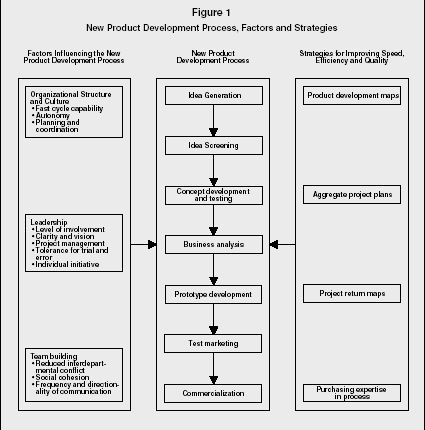 A model of New product Development.
http://www.referenceforbusiness.com/management/images/eom_0005_0001_0_img0129.jpg
Types of Research
| Types of Research - Definitions | |||||||||||||||||||||
| Action research is a methodology that combines action and research to examine specific questions, issues or phenomena through observation and reflection, and deliberate intervention to improve practice. | |||||||||||||||||||||
| Applied research is research undertaken to solve practical problems rather than to acquire knowledge for knowledge sake. | |||||||||||||||||||||
| Basic research is experimental and theoretical work undertaken to acquire new knowledge without looking for long-term benefits other than the advancement of knowledge. | |||||||||||||||||||||
| Clinical trials are research studies undertaken to determine better ways to prevent, screen for, diagnose or treat diseases. | |||||||||||||||||||||
| Epidemiological research is concerned with the description of health and welfare in populations through the collection of data related to health and the frequency, distribution and determinants of disease in populations, with the aim of improving health. | |||||||||||||||||||||
| Evaluation research is research conducted to measure the effectiveness or performance of a program, concept or campaign in achieving its objectives. | |||||||||||||||||||||
| Literature review is a critical examination, summarisation, interpretation or evaluation of existing literature in order to establish current knowledge on a subject. | |||||||||||||||||||||
| Qualitative research is research undertaken to gain insights concerning attitudes, beliefs, motivations and behaviours of individuals to explore a social or human problem and include methods such as focus groups, in-depth interviews, observation research and case studies. | |||||||||||||||||||||
| Quantitative research is research concerned with the measurement of attitudes, behaviours and perceptions and includes interviewing methods such as telephone, intercept and door-to-door interviews as well as self-completion methods such as mail outs and online surveys. | |||||||||||||||||||||
Service or program monitoring and evaluation involves collecting and analysing a range of processes and outcome data in order to assess the performance of a service or program and to determine if the intended or expected results have been achieved.
|
Positioning
Positioning is the fight for the consumers mind. The different marketers want to secure a place in the mind of the target consumer. To do this the marketers use "positioning". What this means is that the marketers want their product to come to mind when the consumer thinks about purchasing that product type.
For example: The marketers of "Lux" soap want the people to think "Lux" when they think soap. The marketers of "Colgate" want the consumers to think "Colgate" when they think toothpaste etc.
In Pakistan "Colgate" comes to the mind of people when they think toothpaste. However, now with intensive competition things are changing.
Positioning a product in the minds of the consumer is becoming harder. However, positioning is going to play a very important role in marketing in an overly competitive environment.
http://www.1000ventures.com/business_guide/crosscuttings/positioning_main.html
Swot Analysis
http://www.youtube.com/watch?v=w2yfkNX1wso&feature=related
This is a link of Swot Analysis video where you have clearly explained how to do a swot analysis of a company. please do visit it, it is very helping and informative.
This is a link of Swot Analysis video where you have clearly explained how to do a swot analysis of a company. please do visit it, it is very helping and informative.

A Brand

A brand as a "name, term, sign, symbol or design, or a combination of them intended to identify the goods and services of one seller or group of sellers and to differentiate them from those of other sellers.
Procter & Gamble, considered by many to have created product branding, is a choice example with its many unrelated consumer brands such as Tide, Pampers, Abunda, Ivory and Pantene.
A good brand name should:
- be protected (or at least protectable) under trademark law.
- be easy to pronounce.
- be easy to remember.
- be easy to recognize.
- be easy to translate into all languages in the markets where the brand will be used.
- attract attention.
- suggest product benefits (e.g.: Easy-Off) or suggest usage (note the tradeoff with strong trademark protection.)
- suggest the company or product image.
- distinguish the product's positioning relative to the competition.
- be attractive.
- stand out among a group of other brands.
Porter's theory of Strong and Weak Competitors

Porter is a recognized leader in competitive analysis elaboration and his five forces model has contributed to the study of competition (Porter 1979). It is necessary to point out that Porter’s approach to alternative strategies’ generation is a well-defined one and is based on the following statement: Company’s position stability in a market is determined by: costs of production and marketing of goods; irreplaceable products; competition’s sphere (the volume of market adaptation).
A company may achieve competitive advantages and strengthen its positions at the expense of: ensuring lower costs on production and marketing of products. Low costs mean the company’s ability to elaborate, produce and sell goods with comparative characteristic features but with lower costs than competitors. A company gets additional profit if it undercuts its products in a market; ensuring that product stays irreplaceable with the help of differentiation. Differentiation means the company’s ability to provide its customer with the product of great value, in other words, with the product of high use value. Differentiation gives the possibility to establish higher prices that brings higher profit. Besides, a company has a choice what market to compete in: the entire market or some its part. This choice can be done using the relation between the market share and company’s profitability suggested by Porter.
Companies which do not have possibilities for becoming leaders in a market must concentrate their efforts on some sector and strive for gaining more advantages with reference to competitors. Large companies become successful with big market share, as well as relatively small companies with narrow specialization. A tendency of small companies to behave the way large companies do regardless their real possibilities, will lead to the loss of competitive advantages. Small companies must follow the rule in order to achieve success: Segment the market. Shrink productive programme. Achieve and maintain maximal share in a minimal market.
Porter’s model is not correct because if every company adopts these strategies, none would be able to have a competitive advantage. Knights does not fully agree with Porter’s theory emphasizing that it is attractive to management because it gives ‘some illusion of control, legitimacy and security in the face of uncertainty’ (Knights 1992, pp. 514-536). Nevertheless, the concept of ‘unequal power’ is supported by senior management worldwide. In general, Porter’s model has some major limitations in today’s market environment. It cannot take in consideration new business models and the dynamics of markets.
http://www.articlesbase.com/college-and-university-articles/porters-five-forces-theory-strong-and-weak-points-176858.html
http://www.nationwidenetworking.com/instancefiles/65257061/30381.jpg
How To develop Copetitive Advantage
Competitive advantage is when you get an advantage over your competitors offering greater value than your competitors offer. This small youtube video tells how to gain competitor advantage over your competitors within the market.
http://www.youtube.com/watch?v=S9O2oPbT3fs&feature=related
http://www.youtube.com/watch?v=S9O2oPbT3fs&feature=related
Competitor Analysis
Some businesses think it is best to get on with their own plans and ignore the competition. Others become obsessed with tracking the actions of competitors (often using underhand or illegal methods). Many businesses are happy simply to track the competition, copying their moves and reacting to changes.
Competitor analysis has several important roles in strategic planning:
• To help management understand their competitive advantages/disadvantages relative to competitors
• To generate understanding of competitors’ past, present (and most importantly) future strategies
• To provide an informed basis to develop strategies to achieve competitive advantage in the future
• To help forecast the returns that may be made from future investments (e.g. how will competitors respond to a new product or pricing strategy?
Competitor Analysis Components
| |||||||||||||


Adapted from Michael E. Porter, Competitive Strategy, 1980, p. 49.
http://www.netmba.com/strategy/competitor-analysis/
Telephone Marketing

Telephone Marketing is a method of direct marketing in which a sales person solicits to prospective customers to buy products or services, either over the phone or through a subsequent face to face or web conferencing appointment scheduled during the call.
Be Natural – Use the Right Equipment
It has been proved in many businesses that customers respond better when the seller (telemarketer) is talking naturally i.e. not holding their hand to their head (holding the phone), or balancing the phone on their shoulders, etc.
To compensate, headsets are extremely useful for allowing you to talk more naturally on the phone – as if you were talking to them face-to-face being able to use your hands, etc.
Practice Makes Perfect
Practising before you begin your telemarketing campaign will pay off allowing you to build your confidence and rectify mistakes early on: role plays are ideal. Of course, your skills and confidence will develop more through experience, but practising will give you a head start. Listen to yourself on a tape recorder – would you develop an interest?
Don’t Go Blank – Use Notes
Stick notes to your desk, phone or wall to help ‘jog’ your memory for persuasive words, phrases, discussion areas, etc. There is nothing worse than pausing to collect your thoughts and comments when trying to sell over the phone: be ready to reply to anything.
Avoid Insulting the Customer
Obvious, right? Well, people do it without even realizing by using comments like "did you understand that?" and "are you following what I’m saying?". This automatically shrinks the customers’ intelligence and ability to catch on. It is down to your own ability to make the customer understand and therefore if you feel the customer is failing to do so, use comments such as "did I explain that clearly" and so on.
Give the Customer a Friend they can Trust
Make customers feel as if they are talking to a friend by making yourself come across as the person that everyone wants to know. Be friendly, be concerned, assure them, praise them – anything that makes them develop a sense of trust: trust goes a long way.
Sales Promotion Objectives

Sales promotion:
Sales promotion plays a vital role in inducing the consumer to buy your product. Sales promotion work includes all those activities, which are directed towards promoting sales.
In short, sales promotion is any activity, which improves the effectiveness of personal selling and advertising.
Sales promotion devices can include premiums, coupons, contest, temporary price reduction, free goods, letters to trade, literature, educational material, displays and trade shows. Sales promotion takes into consideration the communication gaps that always exist between the producer and the consumer. Sales promotion should therefore be closely coordinated with advertising the personal selling.
Objectives:
The sales promotion program are made to accomplish the following objectives:
To introduce a new product.
To increase the inventories of middlemen and consumers.
To increase a products rate among existing consumers.
To attract new customers.
To counter a competitor's sales promotion and other activities.
To reduce a seasonal decline in sales.
To make it easier for salesmen to secure more orders and arrange displays in retail stores.
http://www.salespromo.com/salespromotionplanning.htm
http://www.blurtit.com/q514629.html
Sale Process

A sales process is a systematic approach to selling a product or service. The selling process has six key steps. Virtually every sales interaction will follow these steps, whether it lasts several minutes or several months:
- Prospecting
- Initial Contact
- Sales Presentation
- Handling Objections
- Closing the Sale
- Follow-Up and Service after the Sale
http://www.better-sales-and-selling.com/image-files/salesprocessmodel.jpg
Team Selling
Team selling is the practice of using teams of people from various company departments to sell to a large account. A large account can be complex with multifaceted purchasing decisions so therefor more than one specific sales department can be used. Additional departments usually not used for selling may include technical support teams, finance departments, management personnel, and even engineering. Sales and marketing departments are usually always present in the team marketing mix.
there are three main points through which team selling can give effective results
there are three main points through which team selling can give effective results
- Team approach to selling, which encourages people within your company to work together to achieve a common result.
- Increase ability to sell to senior management.
- Develop an effective planning process for the sale.
Direct Marketing

Direct Marketing describes a collection of tactics and communications channels via mail order, Internet sales, personal sales, etc. It also an approach to marketing which aims to create and continue a direct relationship between an organisation and its customers on a one-to-one basis. Direct marketing offers the powerful benefit of providing an ongoing relationship between company and customers. Direct marketing involves direct communication between a firm and its target customers to generate a response or transaction. Direct marketing also involves the use of a much wider range of different forms of communication than advertising. These include mail (direct mail/catalogues), telephones (telemarketing), the traditional broadcast and print media (direct response advertising via television, radio, newspapers and magazines), and new electronic media (the Internet).
Sunday, January 10, 2010
Pricing Strategies
There are many ways to price a product. For Example:
Penetration Pricing.
The price charged for products and services is set artificially low in order to gain market share. Once this is achieved, the price is increased.
Economy Pricing.
This is a no frills low price. The cost of marketing and manufacture are kept at a minimum. Supermarkets often have economy brands for soups, spaghetti, etc.
Price Skimming.
Charge a high price because you have a substantial competitive advantage. However, the advantage is not sustainable. The high price tends to attract new competitors into the market, and the price inevitably falls due to increased supply.
Psychological Pricing.
This approach is used when the marketer wants the consumer to respond on an emotional, rather than rational basis. For example 'price point perspective' 99 cents not one dollar.
Product Line Pricing.
Where there is a range of product or services the pricing reflect the benefits of parts of the range. For example car washes. Basic wash could be different then the whole package would be different.
Optional Product Pricing.
Companies will attempt to increase the amount customer spend once they start to buy. Optional 'extras' increase the overall price of the product or service. For example airlines will charge for optional extras such as guaranteeing a window seat or reserving a row of seats next to each other.
Captive Product Pricing
Where products have complements, companies will charge a premium price where the consumer is captured. For example a razor manufacturer will charge a low price and recoup its margin (and more) from the sale of the only design of blades which fit the razor.
Product Bundle Pricing.
Here sellers combine several products in the same package. This also serves to move old stock. Videos and CDs are often sold using the bundle approach.
Promotional Pricing.
Pricing to promote a product is a very common application. There are many examples of promotional pricing including approaches such as BOGOF (Buy One Get One Free)
Geographical Pricing.
Geographical pricing is evident where there are variations in price in different parts of the world. For example rarity value, or where shipping costs increase price.
http://marketing.about.com/cs/advertising/a/pricingstrtgy_2.htm
Online Marketing
Internet marketing, or online marketing, is evolving into a broader mix of components a company can use as a means of increasing sales - even if your business is done completely online, partly online, or completely offline. The decision to use Internet marketing as part of a company's overall marketing strategy is strictly up to the company of course, but as a rule, Internet marketing is becoming an increasingly important part of nearly every company's marketing mix. some online businesses, it is the only form of marketing being practiced.
http://en.wikipedia.org/wiki/Internet_marketing
Internet Marketing Objectives
Essentially, Internet marketing is using the Internet to do one or more of the following:
- Communicate a company's message about itself, its products, or its services online.
- Conduct research as to the nature (demographics, preferences, and needs) of existing and potential customers.
- Sell goods, services, or advertising space over the Internet.
http://en.wikipedia.org/wiki/Internet_marketing
Subscribe to:
Posts (Atom)