Showing posts with label Thoughts and Afterthoughts. Show all posts
Showing posts with label Thoughts and Afterthoughts. Show all posts
Tuesday, January 12, 2010
Competitor Analysis Across Deparments
Did you notice during our talk on competitor analysis that this solely marketing information goes to affect decisions taken on the production floor to budgetary meetings, the topics we're covering in managerial accounting? How inter-connected!

Monday, December 7, 2009
Thought of the Day: Protopying
 "Prototype as if you are right but listen and observe as if you are wrong: this approach develops better solutions faster, and forces you to never settle."
- Diego Rodriguez,
Stanford University.
What thoughts do you have?
Is disorder is more efficient than order
Is disorder is more efficient than order

Have you ever observed that many busy, working people, who are really competent and intelligent, have their study rooms, offices, etc., full of disorder, almost as chaotic as Pakistani society? Do you think it is negative and inefficient to have disorder rule over one's living place(s)? i feel this, others may relate to it, that disorder is a good friend of mine. It does not bother me, rather it helps me by saving my time which would have been consumed in establishing the order, which never stops to diminish. Disorder is natural to happen, it'd take place, look what entropy says, but can it be really more productive than having order in 'working places'?
Sunday, December 6, 2009
How to remain ever more creative while protecting your ego from egoism?
The talk speaks for itself. (Notice: No PowerPoint. The magic of storytelling.) Basically, the author and creative writer, Elizabeth Gilbert talks "about a different way to think about creative genius". Essential for those busy in creative acts and groundbreaking for those willing to be creative.
(Visit the site if view is not perfect: http://www.ted.com/talks/view/id/453)
(Visit the site if view is not perfect: http://www.ted.com/talks/view/id/453)
Thursday, December 3, 2009
The first post that declares to be UNTITLED
 An appeal: After this post appears on blog - Please don't storm the blog with "copy-paste," mostly thoughtless posts, which interest none of us except the person posting stuff for self-appreciation. Yeah, original posts are always welcomed as honorable guests by yours truly or else, and its human nature, perhaps. In order to digest these words, you may like to read this. But I'd wait to be stormed, nonetheless, (for no more than few seconds), it's not not to be.
Our predecessors, previous sophomores, used to that, and sir Mannan called them clever. We're no more cleverer if we just imitate our elders, every new generation is more intelligent and cleverer than the older. Who are you?
********
Last year, sir Manan introduced us to the world of blogging, as a new avenue for learning. He opened our mind to new vistas of learning where one actively participates by generating, by producing ideas as well, not just consuming whatever is fed to him.
I was on. And with blogging day-in day-out, I caught the attention unintentionally of a leading blog-zine of Pakistan, where writers of the stature of Dr. Shereen Mazari, and many writers from all over the world write on diverse topics, The Pakistani Spectator. They interviewed me. And offered me to write there, (for some technical reasons I failed to produce any masterpiece to get published).
You can read my interview here. I thanked our professor for this recognition I gained. Recognition is what we need.
Last year, sir Manan introduced us to the world of blogging, as a new avenue for learning. He opened our mind to new vistas of learning where one actively participates by generating, by producing ideas as well, not just consuming whatever is fed to him.
I was on. And with blogging day-in day-out, I caught the attention unintentionally of a leading blog-zine of Pakistan, where writers of the stature of Dr. Shereen Mazari, and many writers from all over the world write on diverse topics, The Pakistani Spectator. They interviewed me. And offered me to write there, (for some technical reasons I failed to produce any masterpiece to get published).
You can read my interview here. I thanked our professor for this recognition I gained. Recognition is what we need.
How Sir Sharukh Got it Wrong?
In explaining U.S. or West's financial fallout, even though our professor went to great lengths, talking of consequences and root causes ,as per his wisdom; but, according per Roger C. Altman what he had to say is not correct. Roger Altman was U.S. Deputy Treasury Secretary in 1993-94.
Sir Sharukh Irfan (F. C. C. Univ.'s accounting/economics professor) was of the view that this meltdown of U.S. markets was due to the collapse of sub-prime mortgage market in the United States; and consequently housing prices collapsed and thus emerged the crisis at the surface. The same reason has been attributed by Altman, in his article in the latest Foreign Affairs magazine, as "conventional wisdom". And, as per Sir, at the root cause of financial melt-down was the preceding reason, it had various consequences we are so concerned with, naturally.
While, on the other hand, Roger said:
"This is not correct [that crisis is due to collapse of subprime mortgage market and housing prices]; these were themselves the consequence of another problem. The crisis' underlying cause was the combination of very low interest rates and unprecedented levels of liquidity."*
Roger sounds more reasonable to me and especially the lethal combination he mentioned. What is your opinion on this issue? Please do share with us.
* Quoted from, The Great Crash 2008: A Geopolitical Setback for the West, Foreign Affairs, Jan/Feb, 2009, Vol 88, No. 1.
Use Dark Colors in Your Presentation Slide Background
Try to use dark colors in your presentation slides background, especially if you're presenting to executive. Why? Simple. Dark color is not a color at all, it's the absence of a color. Therefore, 'it's soothing to the eyes'. Moreover, your audience are allowed to narrow down their focus on the written words. Steve Jobs perhaps made a good use of this principle.
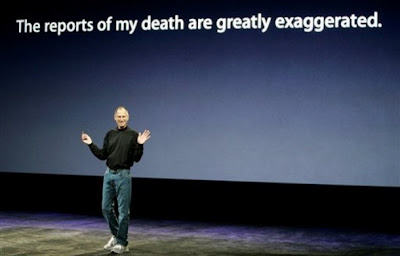 (This tip was bestowed on us by our strategy professor.)
 (This tip was bestowed on us by our strategy professor.)
A Product-loving Entrepreneur's Dilemma
According to a leading entrepreneur in Pakistan, services and products (both a form of business) are as if two opposing realities, as the difference between these two modes being very sharp. He observes that a service (for example, the job of a surgeon which deals with standard cases) requires the service provider to execute what he's best at in the best manner in order to 'create value'. The problem with making a new product, however, according to him, is that there's no repetition involved to save the day; rather, every time a company commences to develop a product that must be different from what is being offered in the market, it needs a whole new set of capabilities, technical expertise and organizational skills just to innovate a product, not many products. Moreover, another dilemma is that this, unlike providing tedious service(s), consumes an excessive amount of energy and resources. "Burn rates", like stakes, are very high.
Thoughts please?
Thoughts please?
Subscribe to:
Posts (Atom)